Johannesburg Council Blames Illegal Miners for Road Collapse
Council member Kenny Kunene points to zama zamas for sinkholes, but experts argue formal mining operations are the primary cause of ground instability.
By Joseph Brooks ·
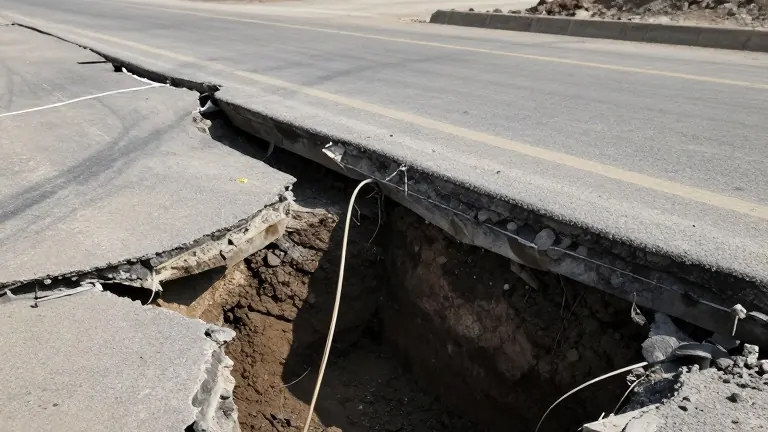
Johannesburg council member Kenny Kunene took journalists on a tour of collapsed road sections in May, attributing the damage to illegal miners. He identified the zama zamas as the primary cause of sinkholes, including a total collapse on Wemmer Pan Road. This road once connected the central business district to south-eastern suburbs. In the collapsed section, the asphalt is gone, leaving raw earth pitted with excavation holes. Kunene framed the issue for the local elections scheduled for November 4.
The illegal mining operation has intensified near Roodepoort, west of Johannesburg. Cora Bailey, who has treated injured animals in the area since 1991, reported that dozens of miners arrived in late September. They dug for gold across the dirt road from her charity, Claw. The miners began taking water from the organization's two 25,000-litre tanks. These tanks serve roughly 100 rescued animals and are filled irregularly by the city government. Bailey closed the gate at midday in mid-October because only two buckets of water remained.
Police in South Africa reported arresting 71 suspected illegal miners across the country on October 19. Officers told Bailey that the scale of the operation was too large for them to manage effectively. A week after the miners arrived, officers cut the grass that had hidden the diggers. A smaller group returned a few days later, though Bailey said they now used the water only for drinking.
Researchers estimate that tens of thousands of illegal miners operate in the region. In 2019, Marcena Hunter of the Global Initiative against Transnational Organised Crime estimated that one tenth of South Africa's gold production was exported illegally. That volume was worth approximately 1 billion dollars. The majority of these miners are from neighboring countries, principally Lesotho, Mozambique, and Zimbabwe.
Experts dispute the council's claim that illegal miners are the main cause of sinkholes. Rosalind Morris, an anthropology professor at Columbia University, noted that the porous dolomitic rock becomes unstable when water is removed. She stated that formal industrial mining removes hundreds of millions of gallons of water daily. Morris argued that while intense illegal mining causes some structural collapse, the idea that zama zamas invented the problem is fallacious.
David van Wyk, lead researcher at Bench Marks Foundation, said violence in mining areas is often blamed on the miners. He argued that feuding gangs controlling access to shafts are responsible for shootings, such as the mass shooting in Wedela township in September. Van Wyk described the miners as exploited cheap labor who do not carry guns. The mining minister, Gwede Mantashe, stated in 2025 that there were 6,100 derelict and ownerless mines and 1,170 unsafe mine openings in the country.
The city government claims 40,000 tonnes of gold remain underground in the region. Mining companies are legally required to seal old shafts and rehabilitate the environment. However, costs to recover the remaining gold have risen as deposits lie deeper. Vusi Cele, a youth secretary in Khutsong, said illegal miners keep local townships afloat. He noted that without the rents paid by miners, areas would become ghost towns.
Source: The Guardian